Thursday, November 7, 2019

November 7--Pain Has Its Place and Purpose


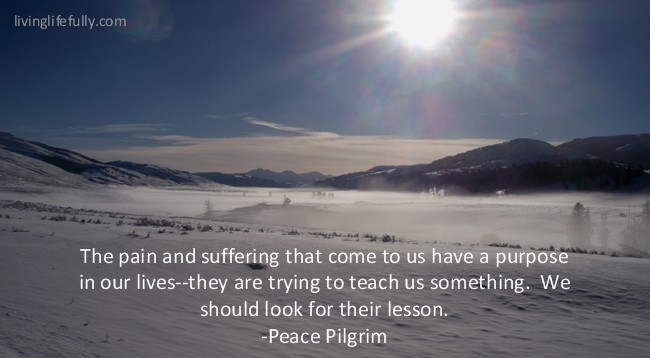
The pain and suffering that come to us has a purpose in our lives--
it is trying to teach us something.  We should look for its lesson.

Peace Pilgrim

* * * * *

Today's Meditation:

I usually don't want this to be true.  Quite simply, it means that many of our most important lessons come through pain and suffering, so if we're people who want to learn important lessons, we must pretty much expect pain and suffering.  On the surface, this seems to be a fatalistic perspective.  In reality, though, we all have to face such things in our lives, and when they do come, it's good to know that they do bring us something more than just the pain on the surface.

Mildred (aka the Peace Pilgrim), isn't telling us that we should invite pain and suffering into our lives, and she isn't telling us that we should celebrate when it does enter into our reality.  What she is telling us is that we should pay attention to it when it's here, for it can bring more to us than itself.  Some of the most devastating breakups have led many people to realize just how self-sufficient they can be; some terrible medical diagnoses have led people to re-examine their lives and bring a new richness and fullness to their reality.

The question we must ask ourselves is how we react to pain.  Do we try to deny it and try to thrust it out of our lives, or do we accept it and try to find out what messages it may be bringing to us?  Are our minds closed to the possibility of learning from suffering, or do we open our minds to possibilities even as the pain makes itself known?

Pain and suffering are something that we spend a lot of time and energy avoiding, and rightly so.  But when they do force their ways into our lives, we must do our best to figure out what they're bringing us other than themselves--they're a part of something bigger and better, if only we can see it.

* * * * *

Questions to consider:

Why do so few of us recognize the positive side of situations that are painful?

What kinds of lessons can be given to us through things such as pain and suffering?

What kinds of important things have you learned from painful situations?

* * * * *

For further thought:

People have a need to feel their pain.  Very often
pain is the beginning of a great deal of awareness.
As an energy center it awakens consciousness.
Arnold Mindell


More on pain.


Wednesday, November 6, 2019

November 6--There Need Be No Loneliness


There is no loneliness if one is satisfied with oneself.

Hans-Ulrich Rieker

* * * * *

Today's Meditation:

I used to spend a lot of time feeling lonely, feeling like I needed someone else around to give me the validation that would make me feel better about myself and my life.  It wasn't until I finally realized just how damaging that perspective was to me--my loneliness was a result of my lack of self-image, and not a result of me being alone.  When I finally became comfortable being alone, not feeling a need for someone else to be there, the loneliness departed.

It's not always easy to feel satisfied with ourselves, especially if we set very high standards for ourselves.  It's not easy to feel that we aren't lacking anything if we believe that things outside of ourselves are necessary for our lives to be complete.  And loneliness can be devastating--in our attempts to avoid it, we may seek out the company of people who are very bad for us, and continue to see them even if we know that they're bad for us.

We all have times when we feel frustrated and disappointed with ourselves, but we need to be sure that we don't let those frustrations lead to an overall dissatisfaction.  If we do, we face the possibility of bringing other feelings such as loneliness and depression into our lives, and we really don't need such feelings around, do we?

We can be satisfied with ourselves even when we're alone.  And loneliness isn't necessarily a natural result of being alone--our time alone can be some of the most valuable and interesting times of our lives if we focus on the possibilities that are present in each moment instead of what isn't there.

* * * * *

Questions to consider:

How do you define loneliness?  Why is it such a difficult feeling for so many people to deal with? 

What are some of the most important elements of being satisfied with ourselves?

Why do so many of us have difficulties being by ourselves?

* * * * *

For further thought:

When we cannot bear to be alone, it means we do
not properly value the only companion we will
have from birth to death--ourselves.

Eda LeShan


More on solitude.


Tuesday, November 5, 2019

November 5--Need or Greed?


The weakness of our age is our apparent inability to distinguish
our needs from our greeds.

Dan Robinson

* * * * *

Today's Meditation:

It's been going on for quite some time:  people in marketing and advertising have been doing their best to make us feel that we need certain things that aren't actually needs, but wants.  And it's working, too--there are many, many people in the world who have a difficult time distinguishing between needs and wants, and many others who want something so badly that they allow someone else to convince them that they need it.  After all, that's how a consumer-based society functions, isn't it?

In business, it astonishes me to see that banks and business strive for a seven-billion dollar profit instead of a four-billion dollar profit.  Instead of keeping it as profit, those extra three billion dollars could go towards hiring and training new people and improving and expanding services for customers.  But those things aren't in their lists of priorities, it seems, and a four-billion dollar profit just isn't enough.  That's greed.

We do need to have enough to eat in our lives, and we do have to have shelter and clothing.  These things are needs.  We also need to have time to relax, and we need to have relationships with others.  We need to have some level of security, and we need to have available health care.  Some couples live in 250-square foot RV's, and their needs are met nicely; I know other couples who live in 2500-square-foot mansions, all by themselves.  That's greed, too.  Sometimes it's greed born of insecurity and fear, but it definitely is a case of people using more resources than they need for no really good reason.

If we want to distinguish between our own needs and our greed, then we first must be aware of things that we wish we had.  And then we need to be honest.  As I grow older and gain more experience with things, this gets easier for me, and I get by with much less, and I recognize my wants vs. my needs much more easily.  And the best part is that when I do see the difference, my life grows much more simple.

* * * * *

Questions to consider:

Why do we sometimes convince ourselves that we need something when we really don't?

How much of an effect do marketers and advertisers have on our perspectives towards the things we want?

Why do so many people make greed a way of life?

* * * * *

For further thought:

Our desires always increase with our possessions.
The knowledge that something remains yet unenjoyed
impairs our enjoyment of the good before us.

Samuel Johnson


Monday, November 4, 2019

November 4--Let the Past Be


We should have no regrets.  We should never look back.  The past
is finished.  There is nothing to be gained by going over it.

Rebecca Beard

* * * * *

Today's Meditation:

If we were to gauge the importance of different things in our lives based on how much we think about them, how much we fret about them, how much time and effort we spend wishing they were different, then most of us probably would find our past way up there on the list.  We do spend tons of time in the past, from talking about yesterday's football game to wishing we hadn't said what we said three days ago, to thinking about some sort of glory days when we had tons of friends and lots to do and life was good.  But like Rebecca says here, there really is nothing to be gained by looking back at our pasts, except perhaps learning the lessons that we need to learn from our mistakes.

Right here and right now, I have a life to live.  I have lots of choices about things to do and places to be and people to help.  The here and now is the most important part of my life, for only  right now can I affect my life in positive ways, and even affect my future by choosing to do something positive in the now.  But if I squander the moments I have in my now by focusing on regret about something I did or didn't do in the past, I'm definitely losing many opportunities, moment by moment, of improving myself and improving my life.

It's important that we recognize and acknowledge mistakes that we've made.  But once we've done that, it's time to move on and continue with our lives--continuing to dwell on those mistakes in the form of regret doesn't help us a bit.

Let the past be.  No, you didn't tell that other person what you felt before he or she left or passed on, but you can tell people today what you feel about them.  Yes, you did make a huge mistake, but now it's time to make amends for it and focus on not making more such mistakes in your present.  Regret does nothing for us, and living in the past sabotages our present; right now is the only time we have to do good, so let's do all the good we can.

* * * * *

Questions to consider:

How do so many people come to have deep regrets that they're unable or unwilling to let go of?

What good does it do us to continue to allow our minds to focus on the past?

How might we teach ourselves to recognize when we're dwelling on regrets, and how to pull ourselves out of them?

* * * * *

For further thought:

Make it a rule of life never to regret and never to
look back.  Regret is an appalling waste of energy;
you can't build on it; it's only good for wallowing in.

Katherine Mansfield


more thoughts and ideas on the past


Sunday, November 3, 2019

November 3--There Are None Who Are Ignorant


The characteristic of the ignorant person is that he or she strives to be other than what he or she is. . . . To the enlightened one, there is none who are ignorant.

Yoga Vasistha

* * * * *

Today's Meditation:

In our culture, of course, we tend to use the word "ignorant" as an insult, though the word has negative connotations only if we perceive it to have them.  An ignorant person is simply someone who doesn't know something--for example, I'm completely ignorant when it comes to calculus, and I would have no problems being called ignorant about calculus.  That said, Vasistha's words here make sense--he's simply talking about "the characteristic of the person who is not enlightened."  But then he turns the idea on its head by saying that the enlightened person sees that no one is actually ignorant.

To some extent, we go through life trying on different clothes in order to find out what fits.  I'm not a football player, but I played football in high school, and it was fun.  So even though it seemed that I was trying to be something I wasn't, that wasn't really the case--I was simply a non-football player who was playing football for a while.  Likewise, I once was in a community play, and I was a non-actor who for a short time was acting.  Was I ignorant to try to be something I wasn't?  Or was I just trying on a different shirt for a while to find out what it felt like to wear it?

The enlightened person realizes that there really is no room for judgment.  Even if this person is trying to be someone or something else, then that person is going through something that he or she needs to experience in life.  Perhaps the person needs to learn about authenticity or dissatisfaction, and the best way for that person to learn is through such an experience.  While it's easy for us to say, "You should be yourself," if the other person hasn't yet discovered his or her self, then how are they supposed to do that?

One thing I've learned about life holds true:  people do some weird stuff.  And trying to be other than what we are is weird, but it also can be very valuable (as most weird stuff can).  And if we claim any sort of level of enlightenment at all, we must realize that it isn't for us to judge what others are doing, for we have no idea what their path calls them to do.

* * * * *

Questions to consider:

Why does it seem that so many people are trying to be something other than what they really are?

What does it mean to be enlightened?

How can trying to be something that we're not actually help us in life?

* * * * *

For further thought:

If I could define enlightenment briefly I would say
it is "the quiet acceptance of what is."


Saturday, November 2, 2019

November 2--Allowing Ourselves to Grow


True growth is a process which one allows to happen
rather than causes to happen.

Gerald May

* * * * *

Today's Meditation:

Gerald gives us another way of looking at the concept of letting go--allowing life to bring lessons to us rather than trying to find and go through only those lessons that we want to go through, or paying attention to only those things that we feel are important at the time.  The truth is that life will give us all sorts of wonderful lessons that will help us to grow in spirit, in mind, and at heart if only we're willing to pay attention to what life is saying to us.

Unfortunately, many people don't seem to want to grow except in ways that they've chosen for themselves, and as people with limited perspectives, we aren't really the best ones to be choosing our own lessons.  After all, if we don't know something, how do we know that we're supposed to learn it?  How do we know that we could use some growth in the area of compassion unless life sends us a lesson that shows us what we need?  How do we know that we should take more time to rest if life doesn't give us that lesson?

But of course, the lesson is only half the battle--we have to pay attention to the lesson, and we have to take something from it if we're to say that we've truly grown.  And I believe it's about those lessons that Gerald is speaking--it's not for us to choose which lessons we respond to by growing and developing, but in paying attention to those lessons we become more loving, more caring, more patient.

When we plant a seed in the ground, we don't make it grow.  We simply provide the conditions necessary for the seed to germinate and develop into a plant of some sort.  Likewise with ourselves--by staying aware and accepting of life, we create conditions in which love and compassion and wisdom can grow, and once those conditions are good, we still can't force any of those things to grow--we can only accept the conditions and allow them to grow inside us until they flower or bear fruit--or both.

* * * * *

Questions to consider:

Why do so many of us try to control every element of our lives instead of letting go and accepting what life sends our way?

How might you go about creating the conditions inside yourself for positive things to grow?

What are three areas of growth that you'd like to see in yourself?  Are the conditions optimal for such growth to occur?

* * * * *

For further thought:

The great thing about life is that as long as we
live we have the privilege of growing.

Joshua L. Liebman


Friday, November 1, 2019

November 1--Emotions Shouldn't Drive the Bus


When one is prey to one's emotions,
one is not one's own master.

Baruch Spinoza

* * * * *

Today's Meditation:

I would never argue that our emotions are negative aspects of who we are.  To me, our emotions provide an important guide and meter as to how we're doing in life, and it's important that we honor them and pay attention to them.  But like Baruch, I've seen that if we let our emotions control us, if we allow ourselves to be swayed constantly by those emotions into behaving certain ways and making certain decisions, then we can no longer say that we have any sort of control over our own lives.  We cannot even say that we make our own decisions or our own choices if those decisions and choices are based on our emotions rather than our instinct or our logic.

It is easy to become too attached to our logic, of course, but that's not the point here.  The point is that no matter how valuable they may be, our emotions are not trustworthy indicators of just how things are going or just what is the right decision to make in any given situation.  I love following my instinct, but whenever I feel my emotions getting in the way of any decisions, I see a huge red flag going up, for I know that my thinking isn't necessarily clear when I'm letting my emotions sway me.

We've all seen people make emotional decisions, and we've all had the experience of wishing that they wouldn't do so, wishing that they would wait until they calmed down a bit to react or decide or act.  None of us are ever completely in control of our own lives, of course, but when we allow our emotions to run things for us we definitely are giving up much of the control that we actually do have, and we run the risk of losing any mastery that we may have.

* * * * *

Questions to consider:

What kinds of problems can arise when we let our emotions take charge of our lives?

Why is it so often so tempting to follow our emotions instead of our reason?

How can we be aware of when our emotions are influencing us too strongly?

* * * * *

For further thought:

When you look at things emotionally, you will not see
them clearly; when you perceive things spiritually,
you will understand.


Thursday, October 31, 2019

October 31--Our Differences Can Be Our Assets


I didn't belong as a kid, and that always bothered me.  If only
I'd known that one day my differences would be an asset,
then my early life would have been much easier.

Bette Midler

* * * * *

Today's Meditation:

I was kind of like Bette when I was a kid, always feeling that I didn't belong.  What I've come to learn since then, though, is that most of that lack of belonging came from me, from my own feelings of not belonging, and not necessarily because I really didn't belong.  I felt like I didn't belong, so I acted like I didn't belong.  And as long as I acted like that, how else were other people supposed to treat me?

Much of the way I felt came from the fact that my father was in the military and we moved around rather often.  That meant that I was often starting out in new schools where I didn't know anyone else.  That really didn't end up mattering, as I always made a friend or three to spend time with, but the fact was that even with them, I felt that I didn't belong, and that they were somehow doing me a favor by being my friends.  But again, those were my feelings, not the way that things were.

We don't realize as kids that having a couple of good friends is all that anyone can ask for, and once you have those, it doesn't really matter if you "fit in" with the social order as it stands.  So what if you don't "fit in" with those people who are always wearing the latest fashions, or who are smoking across the street or who are going hunting as soon as the season opens?  You are who you are, and one of the important tricks in life is to be with the people who accept you as you are and enjoy your company--and whose company you enjoy.

We all have differences, but many of us hide them so that we'll "fit in" with others.  Those differences, though, if we develop them and celebrate them, can help us to make something very special and very unique of our lives, so we shouldn't worry at all if we're not just like everyone else--we should be grateful that that's the case.

* * * * *

Questions to consider:

What are some of the major differences inherent in who you are as a person?

Do you ever feel that you don't belong in some sort of setting?  Where do you think those feelings originate?

How might we help ourselves to realize that as human beings, we fully belong to communities of other human beings (except in those situations in which people make a purposeful effort to exclude others)?

* * * * *

For further thought:

The individual has always had to struggle to keep
from being overwhelmed by the tribe.  If you try it, you
will be lonely often, and sometimes frightened.  But no price
is too high to pay for the privilege of owning yourself.

Friedrich Nietzsche


More on individuality.


Wednesday, October 30, 2019

October 30--Gardens of Love and Compassion


If we make our goal to live a life of compassion and unconditional
love, then the world will indeed become a garden where all kinds
of flowers can bloom and grow.

Elisabeth Kuebler-Ross

* * * * *

Today's Meditation:

I think Elisabeth is talking about two different things in the same sentence:  about us making our own lives, our own worlds into gardens, and about us making other people's lives and worlds into gardens.  Both of these things, though, take love and compassion, because without those two qualities shared generously and unconditionally, life never shall be the garden that it has the potential to be, not for you and not for the people upon whose lives you have your effect.

The first thing she says, though, is that the world can become a garden "If we make our goal" to live love and compassion.  A beautiful world for us doesn't just happen--it takes effort to create it, to form it, to develop it, to push it to its extraordinary limits.  If our goal is to be loving and compassionate, then we naturally will commit loving and compassionate actions, and through those actions--as long as we expect nothing in return for them--we can make our lives extraordinary, and we can contribute extraordinary things to the lives of others.

What kind of garden do you wish your life to be?  Do you want to make your life into a lush garden with healthy flowers and plants, or do you want your garden to be dry and barren and full of weeds?  Well, just like a garden, you control the results of your life through what you put into it.  A garden that is treated with love and given all it needs to thrive shall thrive, whereas a garden that is neglected or treated wrongly or poorly shall not thrive.

The question is, what are you giving to your life?  Plenty of water and TLC, or just the bare minimum to allow it to survive, but not thrive?  If that's the case, then perhaps a shift to giving more love and compassion to yourself and others is in order.

* * * * *

Questions to consider:

Why is it important to share the love and compassion that's within us with others?

What can you do today to make the garden of your life flourish?

How often do you share--actively share--your compassion and unconditional love with others?

* * * * *

For further thought:

We're all assigned a piece of garden, a corner of the universe
that is ours to transform.  Our corner of the universe is our own
life--our relationships, our homes, our work, our current
circumstances--exactly as they are.  Every situation we find
ourselves in is an opportunity, perfectly planned by
the Holy Spirit, to teach love instead of fear.


Tuesday, October 29, 2019

October 29--Present Blessings


Reflect on your present blessings, of which every person has many,
not on your past misfortunes, of which all people have some.

Charles Dickens

* * * * *

Today's Meditation:

How many blessings do I have in my life right at this moment?  Oh, my goodness--if I really were to sit down for five minutes and make a list of the people and things and situations in my life that are positive, those blessings would far outweigh my past misfortunes, and they also would outweigh the current negative things, of which there are relatively few to speak of.

Charles gives us some really good advice here.  If we spend our time thinking of misfortunes already past, then our minds are occupied in the present moment with negative thoughts and ideas, and just how can that possibly help us to live in a positive way in the here and now?  We always have a choice as to what we focus on in our minds, and if we choose to keep our minds on negative things from the past, no matter how justified we feel in doing so, we're still keeping our minds focused on the negative.  And what good does that do?

One of the reasons for which I prefer to stay focused on my present blessings is that I've found from experience that the more I stay focused on blessings, the more blessings come my way in the future.  It's like by focusing on the positive, I'm opening a door that lets in more positive; conversely, when I focus on the negative, I'm opening a door for the negative and more negative things push their way into my life.

We've all faced misfortune.  Some of us keep ourselves miserable by continuing to focus on those misfortunes, and not allowing ourselves to open up to the positive.  Others of us, though, allow those misfortunes to lie in the past, where they belong, and we focus on the blessings that we have.  The ability to make the most of our here and now lies in our decisions concerning where we keep our own focus.

* * * * *

Questions to consider:

Why is it so easy for so many people to stay focused on past misfortune?  What good does it do them?

How many blessings do you have in your life right now? 

How might we go about keeping our minds on our blessings?

* * * * *

For further thought:

Let go. Why do you cling to pain? There is nothing
you can do about the wrongs of yesterday. It is
not yours to judge. Why hold on to the very thing
which keeps you from hope and love?


Monday, October 28, 2019

October 28--Efforts for Peace


The world will never have lasting peace so long as people reserve
for war the finest human qualities.  Peace, no less than war, requires
idealism and self-sacrifice and a righteous and dynamic faith.
 

John Foster Dulles

* * * * *

Today's Meditation:

We do spend a lot of money on war.  We spend a lot of time and effort and money and energy on creating things that will harm our fellow human beings because we're afraid that if we don't do so, we'll be vulnerable to attack and conquest, that we'll lose our chosen way of life and be forced to live the ways that other people want to force us to live.  What would happen, I wonder, if we were to spend just as much money and time and effort pursuing peace? 

What would happen if our peace budget were as much as our defense budget?  What could we accomplish in this world as individuals if we were to focus on creating peace in our own lives, and in our own relationships, as much as we focus on making money and doing things that we think others want us to do?  The finest human qualities to which John refers, I believe, are things like dedication, perseverance, focus on accomplishment, hard work, courage, and sacrifice.  Do we put these things into practice each day in our relationships and into our communities?

There's something about hardship that seems to stimulate our survival instincts.  And once those are stimulated, we seem to be able to reach inside and tap into reserves of qualities that are among the best we have.  It's unfortunate that we so often wait until adversity strikes to reach inside and find those strengths--for they're strengths that could contribute much to the spread of things like peace and community and compassion if we were to apply them to those things.

I can imagine some of the qualities that I might find inside myself in times of great turmoil and struggle.  The trick is to tap into them during other times so that I might use them in ways that will contribute positive things to this world of ours while I'm here.

* * * * *

Questions to consider:

Why do so many people not tap into their finest qualities every day in order to work towards lasting peace?

What does "lasting peace" mean to you?  Is it just a pipe dream, or is it a possibility?

Who is responsible for lasting peace in our world?  Is it just the leaders, or are more of us actually responsible for contributing to it?

* * * * *

For further thought:

The real and lasting victories are those of peace, and not of war.


Sunday, October 27, 2019

October 27--Your Heart Knows


The one thing that doesn't abide by majority rule is
a person's conscience.

Harper Lee

* * * * *

Today's Meditation:

Sometimes I think that Harper's words here should read "The one thing that shouldn't abide. . ."  In our world we all see people doing things that they know they shouldn't do just to be cool, or just to be accepted, or just because others expect to do something.  When we deal with our internal conflicts with our consciences, there's often a good chance that we will rationalize the decision that makes things the easiest for us or the one that's going to get us accolades and/or acceptance.  And here's the scary part--we often allow ourselves to justify what we've done by adjusting our consciences to make the action okay.

Do we have the ability to adjust our conscience?  Can we truly convince ourselves that something wrong is actually right, and not feel the least twinge of remorse for doing that thing or for not feeling wrong about it?  Sometimes, I believe we do--but I also know that not everyone is willing to do so.  Most people aren't even willing to try to do so.

Why is it so difficult to listen to our consciences, though?  Why do we not want to acknowledge what it's telling us to be true or wrong or right?  It really does seem to be that pressure from others that makes things difficult for us, be they friends or colleagues.  But no matter what pressures we face, the final decision about whether to follow our conscience or not rests with us; and the final decision about whether to accept what it tells us lies with us, also. 

Our conscience should not abide by majority rule.  Many people squelch the important voice inside themselves by telling themselves that everyone else thinks a certain way, so why should I think any different?  But the question is not whether you're thinking differently or not, but whether you're following what you know in your heart and soul to be true.

* * * * *

Questions to consider:

What are some of the pressures that weigh against us following our consciences?

Why is it so easy sometimes to just go with the flow and do what everyone else is doing, whether we agree with it or not?

How might you be sure that you keep yourself open to the messages that your conscience is sending you?

* * * * *

For further thought:

Conscience, as a mentor, the guide and compass of every
act, leads ever to happiness.  When the individual can
stay alone with his or her conscience and get its approval,
without knowing force or specious knowledge, then he
or she begins to know what real happiness is.


Saturday, October 26, 2019

October 26--The Power of Your Smile


Life is not made up of great sacrifices and duties but of little
things in which smiles and kindness given habitually are what
win and preserve the heart and secure comfort.

Humphrey Davy

* * * * *

Today's Meditation:

Yesterday I was walking through the elementary school wing of our building and I saw a little girl about five years old walking towards me.  She was wearing shoes that had lights in them, and she looked incredibly friendly.  Our eyes met and we smiled at each other.  "Your shoes are really cool," I said, and her smile grew even bigger and she positively beamed.  Her smile made my day much, much brighter, and it's something that sticks in my mind and brightens each moment that I think of it.

Many years ago, on a cold and dreary winter morning in Salamanca, the same thing happened to me.  A little girl on the street, holding her mother's hand--our eyes met, and we shared a smile that has stuck with me for three decades.  That smile is still with me, while so many other things that I thought might have been very important to me have fallen by the wayside, and are no longer in my mind.  In my life I remember more the smiles and the hugs and the words of encouragement that I've been blessed to give to and receive from others than I remember the jobs or the tasks or even many of the "accomplishments" that I've achieved.

That's why I fully believe in Humphrey's words.  The things that have touched my heart are the things that stay with me and that keep me constantly remembering how positive life can be, how powerful a simple smile can prove.  I've shared such smiles with adults, too, but more rarely--children seem to have a greater ability to include their hearts in their smiles.

I've had very big successes in life, but to be completely honest, if I were to choose which memory I would like to have foremost in my mind all the time, I would choose one of these smiles from people that I don't even know than I would a graduation or an award.  I would choose my wife's smile at our wedding over the wedding itself, and I would choose times spent sharing silence with loved ones over any times spent in cheering crowds.  Life is filled with simple, deep moments, and if we can truly appreciate the depth and beauty of those moments, much of the rest of life becomes much more positive.

* * * * *

Questions to consider:

Why do we tend to undervalue the simple kindnesses that others show us?

What to you is the best part of a shared smile or a simple kindness?

Do you search out opportunities to share smiles and simple kindnesses of your own?

* * * * *

For further thought:

What sunshine is to flowers, smiles are to humanity.
They are but trifles, to be sure; but, scattered along
life's pathway, the good they do is inconceivable.

Joseph Addison


More on smiles.  -  More on kindness.


Friday, October 25, 2019

October 25--Give Thinking a Try


Few people think more than two or three times a year.
I have made an international reputation for myself by thinking
once or twice a week.

George Bernard Shaw

* * * * *

Today's Meditation:

While I recognize that George's tongue must have been firmly in his cheek when he said this, he's not at all far from the truth with this comment.  True thinking is, indeed, rare--rather than think on our own, we tend to react with our thoughts; rather than ponder concepts and ideas carefully, we tend to skim over them with our first reactions and not take our time and think our ways to the core of the matters at hand.

Most of the work that I do, I can do quite easily without tons of effort--and I do it that way.  Most of my relationships I can maintain with a minimum of effort--and I do so, because I can and because other things take up my time and my thoughts.  Most things that I need to think about deeply, I think about superficially, mostly because I don't feel that I have the time to consider something on its own when there are so many other things that need my attention, also.

But our best inventors, our best scientists, our best architects are all people who are able to give their undivided attention to something and stick with it.  They're willing to take the time out of their days and make the efforts to think deeply about one thing for long stretches of time.  I sometimes feel that way when I'm writing, especially novels--they force me to put my mind on the topic at hand and think it through more deeply than I'm used to, and that really is a good feeling when it happens.  Yes, I do neglect other things at those times, but that neglect isn't anything terrible--I just get to other things a bit later.

If we want to really think--to really exercise our minds and our ability to ponder--then we need to make time for it and we need to make the effort clearly and fully.  True thought isn't the multitude of thoughts that race through our minds each day as we go about our business and shift from thought to thought all day long.  True thought is keeping our attention on one thing and considering it from different angles and perspectives, and true thought is something that can enrich us greatly and add a beautiful dimension to our lives.

* * * * *

Questions to consider:

How would you define truly thinking?  How often do you participate in that activity?

Why do we tend to get caught up in our racing thoughts, unable to slow them down or control them?

What are some ways that you can practice thinking at a different level than you think now?

* * * * *

For further thought:

Five percent of the people think;
ten percent of the people think they think;
and the other eighty-five percent would rather die than think.

Thomas A. Edison

Thursday, October 24, 2019

October 24--Don't Skimp on the Praise


Creativity is so delicate a flower that praise tends to make it bloom, while
discouragement often nips it in the bud.  Any of us will put out more and better
ideas if our efforts are appreciated.

Alex F. Osborn

* * * * *

Today's Meditation:

While Alex's words are very true, they can't help us much if we're waiting for others to praise our creativity.  If we wait for someone else to compliment us or encourage us, we could end up waiting a very, very long time and becoming very discouraged.  That's why when I look at words like these, I think about the other people in my life and the positive effects that I can have on them.

Sometimes I find it especially difficult to be encouraging about creativity because I simply don't like something creative that someone else has done.  It may be aesthetically unpleasing to me, it may offend me, it may make be feel nauseous--whatever the reason, there are simply some creative things that I don't like, just as I don't like sushi or coconut or any number of foods.  In that case, though, it's important that I put my likes and dislikes aside and try to focus on the fact that someone has spent time and effort creating something, and I now have the choice between encouraging or discouraging.  After all, just because I don't like something doesn't mean that it isn't good.  As long as I'm aware of the choice, it becomes much, much easier.

The up side to me being encouraging is that my encouragement may contribute directly to there being more creative material in this world of ours.  Any time that someone reaches inside and takes the risk necessary to create, the world becomes richer and there is more potential in it, simply as a result of the creative work of individuals.  And I can be a part of that when I give kind words of praise for someone's creative efforts.

* * * * *

Questions to consider:

How do we tend to respond when we don't like something, even if we recognize the creativity and talent behind it?

Why is praise so important for so many of us?

What kinds of praise do you most like to hear?  Do you give that same kind of praise to others?

* * * * *

For further thought:

Most of us, swimming against the tides of trouble the
world knows nothing about, need only a bit of praise
or encouragement-- and we will make the goal.

Jerome P. Fleishman


More on encouragement.


Wednesday, October 23, 2019

October 23--Almost Nothing Stays Unknown


Live as if everything you do will eventually be known.

Hugh Prather

* * * * *

Today's Meditation:

I long ago gave up on the idea that I can do anything that won't be found out.  No matter what my motivation for doing what I do, I've learned that pretty much everything that I do eventually becomes known by someone, and therefore it's important that I do only those things that I'm fine with other people knowing--especially where other people are concerned.  There really are no secrets, after all.

But what I like about Hugh's words is the fact that he's not talking about living this way just to preserve your good name or to stay out of trouble.  What he's giving is advice that will help us to consistently make decisions that are healthy and worthwhile, decisions that will make us good people and that won't allow us to do things that are destructive or harmful.  If I constantly make decisions based on the assumption that others will know what I've done, I don't have to do so just to preserve my good name in their eyes; rather, I do so because I want to lead a good life.

Sometimes it's very hard to see which decision would be best, especially if one might benefit us in ways that are possibly unethical or that present a double standard.  I would take Hugh's words even further to say "eventually be known to a very young person who trusts you completely to do what's right."  In that case, my decisions will be much, much easier to make.

I don't think we even have to live "as if," for the truth is that all that we do is known by us.  And while I don't recommend being harsh judges of ourselves, I do think it's important that we have some kinds of standards that we can live by, and that we can apply to our lives so that our decisions are easier, better, and more able to stand the tests of time and scrutiny.

* * * * *

Questions to consider:

How often do you think about others finding out about things that you've done?  Does that often help you?

What's the difference between fearing the judgment of others and wanting others to recognize the good in you?

What does it mean to you to think that everything you do eventually will be known by others?

* * * * *

For further thought:

Peace of mind just can't be bought.  Trust me:  Even if your conscience
doesn't stop you from playing dirty to get what you want, once you get
it, it will keep you from enjoying it.


Tuesday, October 22, 2019

October 22--Talents and Goals


Emptiness is a symptom that you are not living creatively.  You either have no goal
that is important enough to you, or you are not using your talents and efforts
in striving toward an important goal.

Maxwell Maltz

* * * * *

Today's Meditation:

Whether or not we're working towards something that's important to us always is a question of choice.  It may be that our jobs don't allow us a lot of opportunity to be creative and daring, but we don't live our whole lives at our jobs.  Life is about giving and sharing, after all, and it's important that we find every opportunity that we can to do so, or else we will feel that sense of emptiness that Maxwell is talking about.

Some of the happiest people I've ever known have been those who have set up a shop or a crafts room where they can pursue things that interest them, things that they can share with others.  In this way, they're able to use their talents on something productive, something that calls to them most days and says, "Come make use of those great talents that you have!"  I read an article once about a woman who started propagating and growing flowers and houseplants for shut-ins, and just this new hobby of hers pulled her back from depression and despair and gave her something to look forward to in life.

Perhaps you don't have a goal like that college degree that could help you get a promotion, or a certain sales figure, or a certain amount of money in savings by a certain time.  Perhaps instead you'd like to meet a certain number of people in the next few months, or finish that short story or poem or novel by a certain date.  If this is the case, then make concrete goals out of these things, and pursue them as important, vital goals.

We spend far too much time looking outside of ourselves for reasons to thrive.  Such a strategy really doesn't do much for us--we each have our own unique gifts and talents, and it's when we actually put them to use that we're able to benefit from them with a happier and more fulfilling life.

* * * * *

Questions to consider:

Why do so many people neglect to make goals or work with their own special gifts?

What are some of your unique gifts?  How might you put them to use to add a dynamic aspect to your life?

What's one important goal that you haven't made yet because you're afraid you won't be able to reach it?

* * * * *

For further thought:

If you observe really happy people you will find them
building a boat, writing a symphony, educating their children,
growing double dahlias in their gardens, or looking for
dinosaur eggs in the Gobi desert. They will not be searching
for happiness as if it were a collar button that has rolled
under the radiator. They will not be striving for it as a goal
in itself. They will have become aware that they are happy
in the course of living life twenty-four crowded hours of the day.

W. Beran Wolfe


more on goals


Monday, October 21, 2019

October 21--Balanced by Sadness


There are as many nights as days, and the one is just as long as the other in the
year's course.  Even a happy life cannot be without a measure of darkness, and
the word "happy" would lose its meaning if it were not balanced by sadness.

Carl Jung

* * * * *

Today's Meditation:

This concept is one of Jung's most important contributions to my life.  Other people have said the same thing, of course, but long ago when I first read this idea by Jung, I suddenly didn't feel so alone in my down times; I suddenly realized that everyone was going through their own dark times; I realized that there really can't be life without the darkness, and the darkness was no longer as painful to me.  This was during a time when I was going through some rather severe bouts of depression, and Jung's idea did help me to keep in mind that what I was going through was a part of life, and that this, too, would pass.

We learn from darkness just as we learn from light.  We gain new insights, new ideas, new perspectives from going through difficult times, and if our lives were devoid of them, then we never would be able to help other people through their difficult times.  No, we don't search out sadness and depression on purpose so that we can learn from them, but when they do visit us, we can get through them more easily with a healthy perspective, one that tells us that life still goes on in spite of the darkness, and that tomorrow's sun will rise just as it did today and yesterday.

I know people who would consider Jung's words to be pessimistic, who would say things like "why focus on the negative when there's so much positive?"  But there's a difference between negativity and realism, and sadness is simply a natural part of the human experience--when we keep in mind that it is natural and temporal, then we can work our way through it much more easily, and while the pain may not lessen, it should be less destructive.

You will have your nights.  I will have my nights.  And life will go on, and this, too, shall pass.  It's comforting to me to recognize that fact and hold it close to my heart.

* * * * *

Questions to consider:

How can thinking about the dark parts of life help us to get through our bad times?

Would our times of happiness and cheerfulness be as uplifting if they weren't balanced out by times that are difficult?

What are some of the long-term benefits of having gone through difficult sad times in our lives?

* * * * *

For further thought:

Sadness is related to the opening of your heart.
If you allow yourself to feel sad, especially if you can cry,
you will find that your heart opens wider
and you can feel more love and more joy.


November 7--Pain Has Its Place and Purpose

The pain and suffering that come to us has a purpose in our lives-- it is trying to teach us something.  We should look for its lesson. ...